How five of us build and run 25 Roblox games.
Two developers, a builder, a tester, and a game balancer. Here’s how our small team keeps 25 Roblox games running, and what we’ve learned along the way.

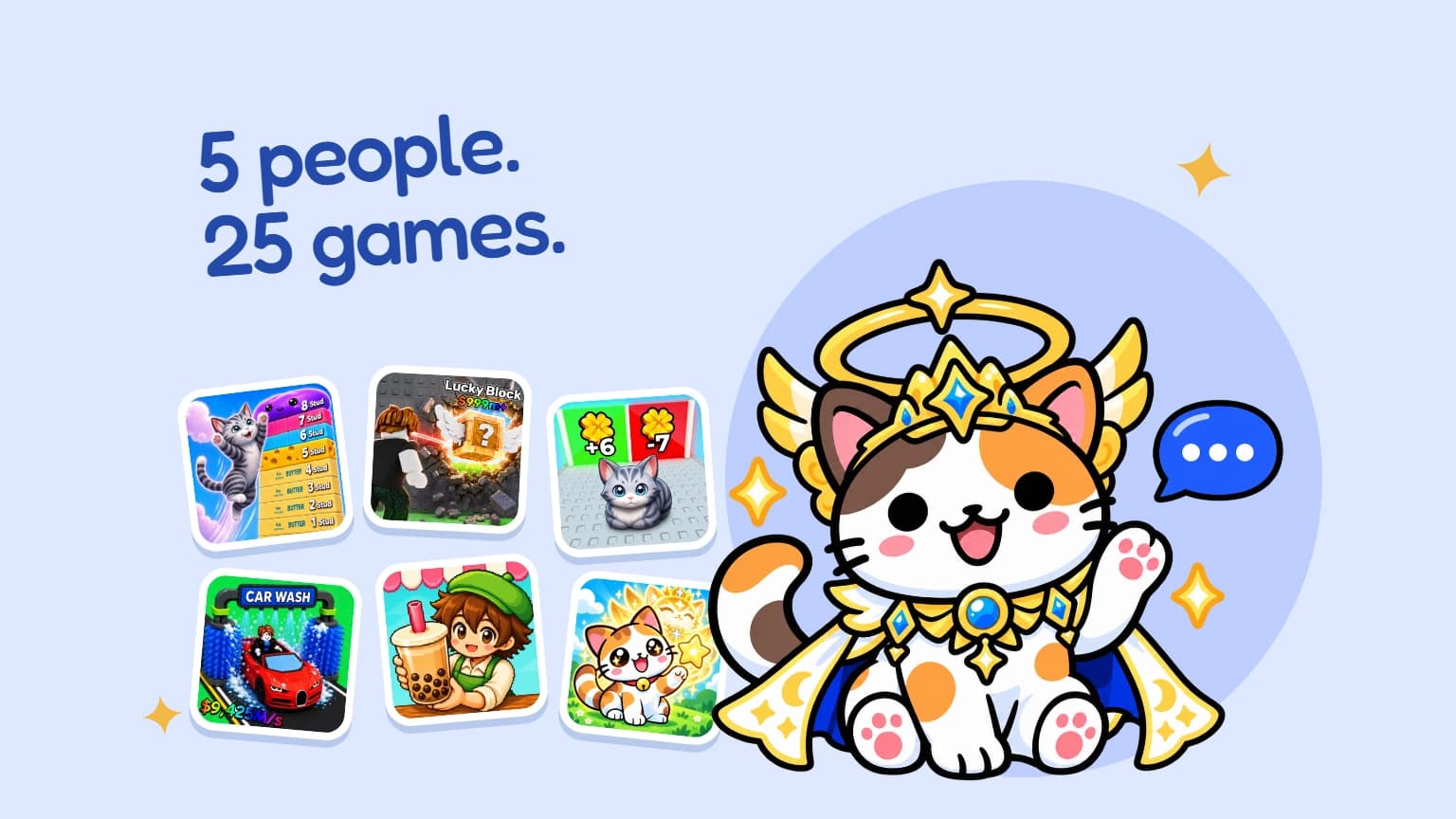
Between October 3 and October 17, we added seven games to the Yeno lineup. That’s a lot for a team of five, and people sometimes ask how we keep up. The honest answer isn’t that we never sleep. It’s that we’ve spent a lot of time building things we can reuse, and we’ve gotten picky about where our time goes.
I’m Charles, one of the developers at Yeno. Here’s how we actually work.
Five people, clear lanes.
Khai and I handle most of the game development: the core gameplay, the systems, and wiring everything together. When a game needs a custom environment or assets we don’t already have, we bring in David to build them.
Once the core game is ready, it goes to Cycles and Danny. Cycles handles quality assurance, hunting down bugs and anything that feels off when you actually sit down and play. Danny handles game balancing, looking at progression and pacing: how quickly you earn things, how upgrades feel, and whether the game is still fun once the novelty wears off.
We make adjustments based on their feedback before anything goes live. Those two steps are a big part of how a small team can release often without releasing broken games.
We don’t start from a blank page.
The biggest reason we can move quickly is that we rarely start from scratch. Over time, we’ve built a set of reusable systems and templates. When we start a new game, we use them as the foundation, then expand or modify them for whatever that game needs.
You can see it in our lineup. Our games tend to come in families: the +1 Escape games like +1 Backflip Keyboard Escape, the Lucky Blocks games like Shoot Lasers for Lucky Blocks!, the Brainrots games, the For Animals games like Cars for Animals, and the Of Hell games like Motorcycle Of Hell. Games in the same family share a foundation, which frees us up to spend our time on what makes each one different.
That doesn’t mean every game is built the same way. Some lean heavily on systems we already have. Others need new features, new mechanics, or custom builds from David. When we’re actively pushing to get a game out, it usually takes about a week to go from idea to release. Some come together faster, and some take longer.
Following what players are into.
Most of our ideas come from paying attention to trends across Roblox. We watch which types of games and gameplay mechanics are gaining popularity, then explore how we can build on those ideas in our own way.
Trends on Roblox can move fast, so being able to build quickly really matters. That’s another reason our reusable systems are so valuable: when a new kind of game starts catching on, we’re not starting from zero.
Launch day is the start, not the finish.
After a game launches, we rely on two things: Roblox analytics and player feedback. The analytics show us how people are actually playing, including whether they stick around and keep coming back. Player feedback tells us what the numbers can’t, like what feels frustrating or what’s broken.
When a game performs poorly, we dig into the data to find out why. Is the core gameplay not landing? Are players leaving early? Is something getting in the way of a good experience? Then we make improvements and fix the issues players report.
Sometimes that turns a game around. Sometimes it doesn’t. Not every game we make is a hit, and that’s okay. If our changes don’t meaningfully improve how a game performs, we stop putting more resources into it and move on to other projects. With five people, our time is the most valuable thing we have, and we’d rather spend it on the next idea than keep pushing one that isn’t working.
The lesson we keep coming back to.
If there’s one thing we’ve learned, it’s this: don’t rush a game just to hit a release deadline.
When you’re used to moving fast, it’s tempting to pick a date and ship whatever you have when it arrives. We’ve learned that releasing something we don’t believe is ready isn’t worth it. It’s better to take the extra time to polish the gameplay, fix the issues, and make the whole experience feel right.
Speed is important, but quality comes first.
That’s why QA and balancing aren’t steps we skip when things get busy. They’re part of every release. Building quickly only matters if what we release is worth playing.
Come play, or come build with us.
If you want to see how all of this turns out, browse our games and jump into one. We’d love to hear what you think, and the best place to tell us is our Discord server.
If you have a Roblox game you’d like to take further, or a brand you’d like to bring to Roblox, take a look at partnering with Yeno. And if you’d like to be part of a team like ours, keep an eye on our careers page. We don’t have open roles right now, but that’s where we’ll post them. In the meantime, you can always say hello.
See you in the game,
Charles
Keep reading.
All posts
How to read your Roblox analytics.
Retention, session time, benchmarks, performance, and player feedback: what we look at in the Creator Hub, and the mistakes we see new Roblox developers make.
Read story